

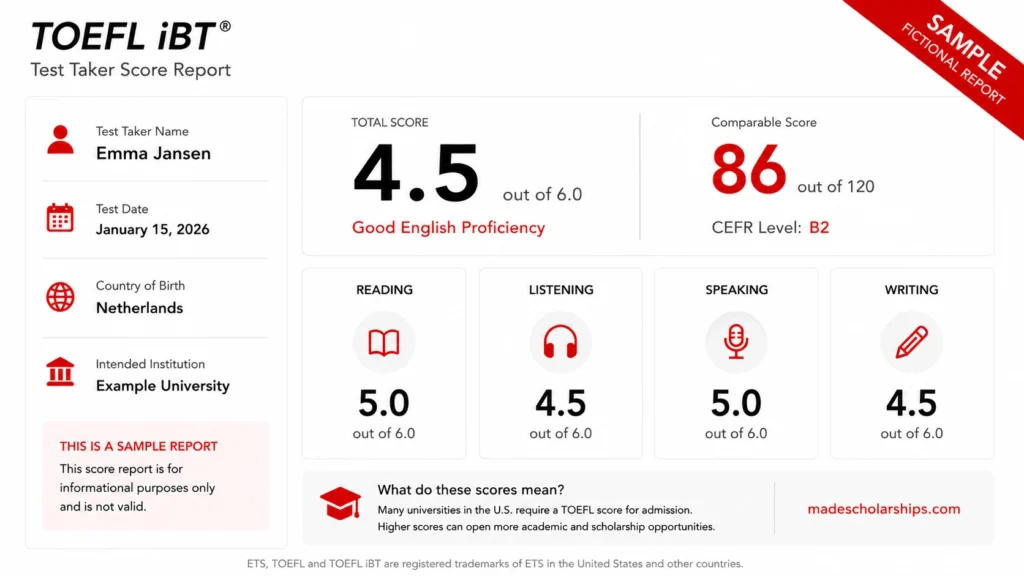
The official TOEFL exam is an important part of the admissions process for international student-athletes applying to US colleges and universities. It can be frustrating if an American coach wants to recruit you, but the admissions office cannot approve your application because you have not met the required English language standard. For international student-athletes, demonstrating English proficiency is generally required for admission when English is not your first language. The TOEFL has also undergone major changes in 2026. Made Scholarships explains what has changed and what you need to know.
What is the TOEFL and why is it important?
The TOEFL is an academic English test that measures four skills: reading, listening, speaking, and writing. US colleges and universities use it to determine whether international students have the English proficiency needed to study in an academic environment.
You can take the TOEFL at an official test center or, depending on availability in your country, from home on your own computer.
Meeting the required TOEFL score—or the equivalent requirement through the IELTS or Duolingo English Test—is generally a condition of admission for international student-athletes whose first language is not English.
The 2026 TOEFL changes explained
As of January 21, 2026, the TOEFL has undergone several major changes. These are the four most important ones:
- The test adapts to your level: The reading and listening sections are now multistage adaptive. This means the difficulty of subsequent questions adjusts based on your previous answers.
- A shorter test: The total test time has been reduced to less than two hours. You still have approximately two hours to complete the full TOEFL exam.
- A new scoring system: TOEFL scores are now reported on a 1.0–6.0 scale. Your overall score is based on the average of your four section scores, rounded to the nearest half point. The new scale aligns with the international CEFR framework.
- A transition period until January 2028: To help universities adjust to the new system, ETS will continue to report a comparable 0–120 score alongside the new 1.0–6.0 score until January 2028.
Who sets the TOEFL requirement: the NCAA or the university?
One of the biggest misconceptions among student-athletes is that a sports organization such as the NCAA or NAIA determines whether you need to take the TOEFL. That is not the case.
The NCAA does not set English-language requirements for college admission. The requirement to take the TOEFL, as well as the minimum score you need, is determined by the admissions office of the individual college or university.
This distinction is important: your athletic division does not determine your TOEFL requirement. A highly selective Division II university may require a higher TOEFL score than a less selective Division I school.
What TOEFL score do you need for a sports scholarship?
Every college and university sets its own minimum English-language requirements. Since January 2026, schools can use the new TOEFL scoring system.
If you already have a TOEFL score from before the 2026 changes, you do not need to worry. Your previous score remains valid. Until January 2028, TOEFL score reports include your CEFR level, your new 1.0–6.0 score, and a comparable score on the traditional 0–120 scale.
Because many universities are still transitioning to the new system, you may encounter both scoring systems. Here is a general guideline:
| Academic level of university | New TOEFL score | Old scale (0–120) | CEFR level |
|---|---|---|---|
| Top-50 universities / Ivy League (e.g. Harvard, Stanford) | 5.0–5.5 | 95–113 (usually 100+) | C1 |
| Highly regarded four-year universities | 4.5–5.0 | 80–94 | B2 / C1 |
| Average four-year universities (D1, D2, NAIA) | 4.0–4.5 | 71–79 | B2 |
| Community Colleges / Junior Colleges (JUCO) | 3.5 | 61 | B1 / B2 |
What do these TOEFL scores mean in practice?
- 80+ (4.5+): You meet the English-language requirements of most four-year universities in the United States.
- 71–79 (4.0–4.5): You meet the minimum admission requirements at many average four-year universities, including NCAA Division I, Division II, and NAIA schools.
- Around 61 (3.5): This is a common entry score for Community Colleges and Junior Colleges (JUCOs). A score of 61 is generally too low for direct admission to many four-year universities, but it can allow you to start your academic and athletic career at a JUCO.
- Below 61: Direct admission becomes more difficult. Some Junior Colleges offer additional English-language support or ESL courses, while another option is to retake the TOEFL.
From our experience, it is relatively uncommon for our Dutch and Belgian students to score below 61 or 71. If your first TOEFL test result is lower than expected, you can always take the test again.
How to prepare: TOEFL practice tests and timing
Take a TOEFL practice test before booking your exam
Before booking your TOEFL exam, take a TOEFL practice test to establish your current level and get an idea of what score you could achieve.
Pay close attention to the date of the practice material you use. A large amount of free TOEFL practice material available online was created before January 2026 and is based on the previous test format and scoring system.
Make sure your practice test reflects the new 2026 TOEFL format and scoring scale.
When should you take the TOEFL during your recruiting year?
Your TOEFL scores are valid for two years. We recommend taking the test before your conversations with US college coaches become more serious.
As a general guideline, Made Scholarships recommends starting your preparation during your fourth year of HAVO or fifth year of VWO, before your final year of high school.
Work backwards from your intended college start date in August and aim to take the TOEFL no later than the fall of the preceding year. This gives you enough time for a potential retake—there must be at least three days between attempts—and for universities to process your scores.
Check your admission requirements before booking the TOEFL
The TOEFL is only one item on a much longer admissions checklist. You may also need translated transcripts, credential evaluations, and other documents, all while working with strict deadlines.
Not sure which admission requirements apply to your target university? Made Scholarships can help you understand exactly what you need.