

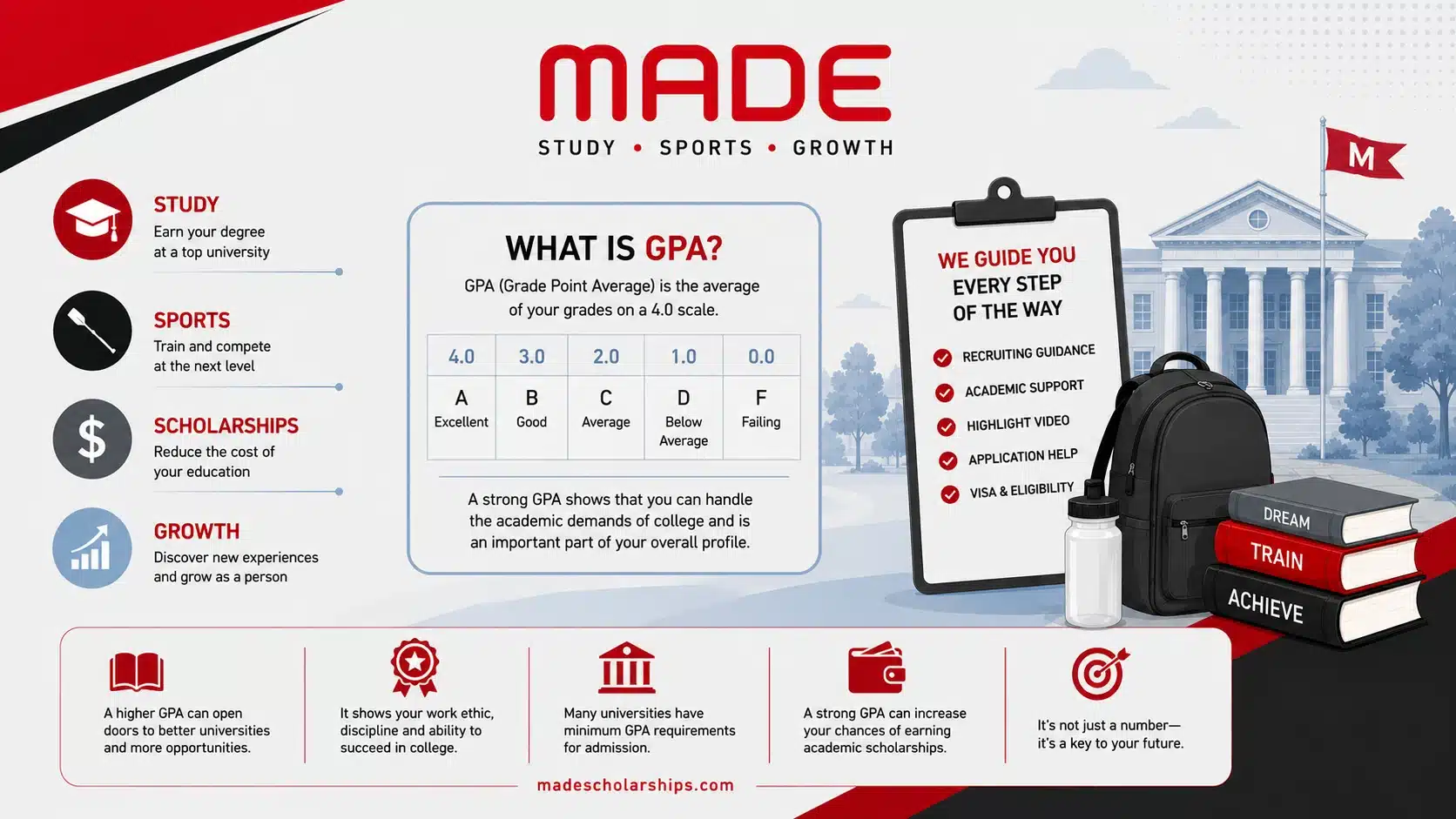
If you want to study and play sports at a US college, you'll run into the term GPA (Grade Point Average) quickly. Coaches ask about it early in the recruiting process, colleges use it for admissions, and it plays a key role in earning and stacking academic scholarships. Still, GPA often confuses international students and their parents. How does a 7 out of 10, a 14/20 or a German 2 convert to a US GPA? What counts as a good GPA? And how much does your GPA really affect your chances of an athletic scholarship? In this article, we explain what a GPA is and how to calculate it. Our free calculator gives you your GPA right away, based on the NCAA's official conversion tables.
Calculate your GPA with our free calculator
Curious about your GPA? Our free calculator shows you in two minutes. Pick your country’s grading scale, enter your grades and instantly see your core GPA, your GPA across all subjects, and where you stand with the NCAA, NAIA and NJCAA.
The Made Scholarships calculator uses the official grading scale the NCAA publishes for your country. The NAIA uses the same conversions.
What is a GPA?
GPA stands for Grade Point Average. It’s the US grade average that colleges and athletic associations (such as the NCAA, NAIA and NJCAA) use to evaluate your academic performance. Most countries use their own grading scale, such as 1 to 10 in the Netherlands, 0 to 20 in France and Belgium, or 1 to 6 in Germany. The US uses a 0 to 4.0 scale tied to letter grades (A, B, C, D, F).
Colleges use your GPA for things like:
- Admission to your program
- Academic (merit) scholarships
- Athletic eligibility through the NCAA or NAIA Eligibility Center
- Admission to honors programs
What does GPA stand for?
GPA is short for Grade Point Average: the average of your grade points. Each course gets a letter grade, each letter is worth a set number of points (A = 4, B = 3, C = 2, D = 1, F = 0), and the average of those points is your GPA.
Do other countries use a GPA?
Most countries outside the US don’t use a GPA. Your transcript shows grades on your own national scale. You only get a GPA once your grades are converted to the US system, either officially by a credential evaluation service or as a first estimate with our calculator above.
How do grades work in US schools?
US schools give letter grades from A (highest) to F (failing). Each letter usually matches a percentage: an A is 90–100%, a B 80–89%, a C 70–79%, a D 60–69% and an F below 60%. Exact cutoffs vary by school. Each letter is worth a number of points, and the average is your GPA.
For an international student-athlete, your GPA is much more than a number on your report card: it’s your academic ticket in.
Why does your GPA matter so much for athletic scholarships?
Many athletes think coaches only look at their athletic performance and recruiting video. That’s a misconception.
A strong GPA helps you in four key ways:
Faster, easier admission
Almost every college has minimum admission requirements. A strong GPA makes it easy for the admissions office to accept you.
Extra money through scholarship stacking
A strong GPA opens the door to generous academic scholarships. Coaches have a limited budget for athletic scholarships. If the college gives you $10,000 in academic aid based on your GPA, the coach needs less from the athletic budget. That way, combining scholarships can bring you close to a full scholarship.
Athletic eligibility
The NCAA, NAIA and NJCAA have strict academic requirements. If your GPA falls below the minimum, you can’t compete, no matter how good you are at your sport.
The coach’s confidence
Coaches would rather invest in student-athletes who have shown they take school seriously. A good GPA shows discipline, responsibility and time management.
Conversion table: Dutch grades to GPA
Every country has its own conversion table. Here’s the one for the Netherlands as an example, since the NCAA and the NAIA use the same table for Dutch grades. Each grade is first rounded to a whole number, just like on a Dutch transcript: a 6.5 becomes a 7 and a 6.4 becomes a 6.
| Dutch grade | Letter grade | Grade points |
| 10, 9 or 8 | A | 4 |
| 7 | B | 3 |
| 6 | C | 2 |
| 5 | D | 1 |
| 4, 3, 2 or 1 | F | 0 |
Source: NCAA Guide to International Academic Standards, Netherlands (September 2026), and NAIA International Standards, Netherlands (July 2026).
What is a 4.0 GPA in the Netherlands?
You get a 4.0 GPA with an 8 or higher in all your core courses. Because an 8, 9 and 10 all count as an A, an 8 average is worth as much to the NCAA as a 9.5 average.
How do you calculate your GPA?
You calculate your GPA in three steps:
- Take your final grade for each course in every school year from year 9 onward. Dutch students count from year 2 of HAVO or year 3 of VWO. If your scale only uses whole grades, round each grade first (a Dutch 6.5 becomes 7).
- Convert each grade to a letter grade and points with your country’s conversion table.
- Add up the points and divide by the number of courses. Every course counts equally.
Example: a Dutch HAVO student
HAVO is the Dutch senior general secondary track. Dutch language 7 (B = 3), English 6.5 (becomes 7, B = 3), Math A 7.8 (becomes 8, A = 4), Economics 6.1 (C = 2), History 8 (A = 4) and Social Studies 7 (B = 3). That’s 19 points over 6 courses: a GPA of 3.16.
Which school years count?
The NCAA looks at every school year from year 9 onward, the year most students turn 14 or 15. For Dutch students, Made Scholarships counts HAVO grades from year 2 and VWO grades from year 3.
Which subjects count as core courses?
The NCAA and colleges mainly look at:
- Languages (your native language, English and other languages)
- Math and science (physics, chemistry and biology)
- Social sciences (history, geography and economics)
Courses like physical education, religious studies, art, music or shop are often left out of the official calculation.
What is a good GPA in the US?
There’s no universal minimum GPA that applies to every college. These guidelines show how US colleges generally view your grades:
| GPA scale | US rating | Your chances |
| 3.7 – 4.0 | Excellent (A) | Excellent; eligible for the highest academic scholarships |
| 3.3 – 3.6 | Above Average (B+) | Very strong; excellent admission and scholarship chances |
| 3.0 – 3.2 | Average (B) | Good; meets the requirements of the vast majority of schools |
| 2.5 – 2.9 | Below Average (C) | Enough for admission, but limited academic scholarships |
| Below 2.5 | Academic Risk | Challenging; limited school choice and closer academic monitoring |
What GPA is a B+ or A-?
Plus and minus grades only exist at US schools: an A- is worth 3.7 points and a B+ 3.3. The NCAA doesn’t use pluses and minuses when converting international grades, so each of your courses always becomes a whole letter.
What GPA do you need for an athletic scholarship?
To compete, every athletic association requires a minimum GPA. Colleges can also set a higher bar for admission.
| Association | Minimum GPA | What counts |
| NCAA Division I | 2.3 (with 2.0 to 2.3 you’re an academic redshirt: you can practice and receive a scholarship, but you can’t compete in your first year) | 16 core courses from year 9 (Dutch students: HAVO from year 2, VWO from year 3) |
| NCAA Division II | 2.2 (with 2.0 to 2.2 you’re a partial qualifier) | 16 core courses from year 9 |
| NAIA | 2.3, or 2 of 3: GPA 2.0, top 50% of your class, SAT of 970 or ACT of at least 18 | All your final grades |
| NJCAA | No minimum GPA | A high school diploma* (in the Netherlands: HAVO, VWO or MBO level 3 or 4) |
*Vocational programs almost never meet the NCAA’s 16 academic core courses. For vocational students (such as Dutch MBO level 3 and up), the NAIA and NJCAA are the logical routes.
Division I isn’t always the best choice
At Made Scholarships, we always look for the best opportunities for you, academically, personally and athletically. Everyone dreams of Division I, but it’s often not the best choice for an athlete. That’s why it’s smart to always consider every association and every division.
- Everything you need to know about the NCAA
- Want to know more about junior colleges?
- Maybe the NAIA is a great fit for you
Official GPA evaluation through TEC (The Evaluation Company)
For final admission and eligibility, you usually need a certified, official evaluation report from a recognized credential evaluation service.
Made Scholarships works exclusively with The Evaluation Company (TEC), formerly known as SpanTran. TEC is one of the most respected and widely accepted evaluation organizations in the United States.
Through our partnership, Made Scholarships athletes get exclusive discounts on official evaluation reports:
- Course-by-Course Analysis: special rate through Made Scholarships ($170 instead of $190)
- General Analysis with GPA: special rate through Made Scholarships ($90 instead of $110)
Once your evaluation is ready, TEC sends your official report and certified transcripts straight to Made Scholarships and the college.
Read more about credential evaluation.
Keep your GPA up on campus
Your academic work doesn’t stop when you board the plane. To avoid losing your athletic scholarship, you need to maintain a minimum GPA in college.
Fall below the required minimum? You’ll be placed on academic probation. That means you can’t compete for a semester until your grades are back on track.
Free GPA assessment by Made Scholarships
Not sure whether your high school, vocational or college transcript is good enough to study in the US? Or did you use the calculator and want to know what your result means?
As part of your preparation, Made Scholarships gives you a free, no-obligation GPA assessment. We review your transcripts, filter out the core courses and calculate where you stand. That way you know right away which associations, divisions and colleges fit your profile. Don’t jump to conclusions before you’ve talked to us: there’s a route for almost every athlete.