
Study and row in America with a rowing scholarship
The rowing landscape in America is structured a little differently from other college sports. Women’s rowing is an official NCAA championship sport with significant scholarship opportunities, while men’s rowing falls outside the NCAA and is independently organized through the Intercollegiate Rowing Association (IRA).
How does a rowing scholarship in America work?
One number is particularly important when it comes to earning a rowing scholarship: your 2,000-meter ergometer time. Naturally, American rowing coaches recruit based largely on your physical ability and rowing potential. But your attitude, team spirit and character matter too.
If there is a good fit and a coach offers you a place that works within your budget, you will still need to meet the university’s admission requirements before your final scholarship package can be confirmed.
Combining academic, athletic and international scholarships
In college sports, a full-ride scholarship — one that covers all major costs — based purely on athletic performance is relatively uncommon. That does not mean studying in America has to be unaffordable.
Many student-athletes combine different types of financial aid to make college more affordable. A complete rowing scholarship package can include:
Academic scholarship: financial aid awarded by the university based on your secondary school grades, GPA and test scores such as the ACT or SAT.
International scholarship: additional scholarships or grants offered specifically to international student-athletes.
- Athletic scholarship: awarded by the head coach based on factors such as your 2,000-meter erg time, boat class and racing experience.
- Academic scholarship: financial aid awarded by the university based on your secondary school grades, GPA and test scores such as the ACT or SAT.
- International scholarship: additional scholarships or grants offered specifically to international student-athletes.
Rowing levels and scholarship limits
If you are exploring scholarship opportunities for rowing, it is important to understand that competition levels, admission requirements and available scholarship budgets can vary significantly from one university to another. The information below gives you a general indication of the level you may need to compete at. One important point to keep in mind is that every university and program makes its own recruiting decisions.
More opportunities for women following higher roster limits
Since the 2025–26 academic year, NCAA Division I women’s rowing no longer has a limit of 20 athletic scholarships. Instead, programs can have a roster of up to 68 athletes. Each of those roster spots may be eligible for athletic scholarship funding, although universities still make their own decisions based on their available budgets.
The highest levels of college rowing
This is where you will find many of the strongest rowing programs in the United States, with student-athletes who often have international or national-level racing experience.
Roster limit: Up to 68 athletes
Athletic scholarships: Available
A strong combination of athletics and academics
Many universities offer high-level rowing programs for both men and women. NCAA Division III does not allow athletic scholarships, but schools can offer academic scholarships and other forms of financial aid.
Roster limit: None
Athletic scholarships: Not available
Smaller, but competitive
Division II has a limited number of women’s rowing programs, but it can offer an interesting combination of competitive rowing, academics and financial opportunities.
Roster limit: No NCAA roster limit
Athletic scholarships: Up to 20 full-scholarship equivalents
The main system in men’s college rowing
Many of the strongest men’s rowing programs compete outside the traditional NCAA championship structure.
NCAA roster limit: None
Athletic scholarships: Available
What erg times are coaches looking for; how fast do you need to be?
When evaluating rowing erg times, there is one important rule: the division does not always determine the level of competition. NCAA Division III programs can regularly be faster than lower-level NCAA Division I crews.
Men's heavyweight rowing – 2K ergometer benchmarks
| Level (Tier) | Description & Examples | 2K Erg Time (Guideline) |
|---|---|---|
| Tier 1 | Elite varsity programs (IRA Championship finals contenders) Examples: California, Washington, Harvard, Yale, Princeton | 6:10.0 and under |
| Tier 2 | Consistent IRA qualifiers Examples: Wisconsin, Navy, Syracuse, Penn | 6:10.0 – 6:25.0 |
| Tier 3 | Competitive varsity or elite club programs Examples: Colgate, Drexel, Hobart, Temple | 6:25.0 – 6:40.0 |
| Tier 4 | Varsity and top club programs Examples: Jacksonville, UCSB, Michigan, Trinity | 6:30.0s – 6:40.0 |
Men's lightweight rowing – 2K ergometer benchmarks
| Level (Tier) | Description & Examples | 2K Erg Time (Guideline) |
|---|---|---|
| Tier 1 | Elite varsity lightweight programs Examples: Cornell, Columbia, Princeton, Yale | ≤ 6:30.0s (6:30 and under) |
| Tier 2 | Programs that regularly field lightweight eights Examples: MIT, California, Temple | 6:30.0s – 6:40.0s (6:40 and under) |
Women's heavyweight rowing – 2K ergometer benchmarks
| Level (Tier) | Description & Examples | 2K Erg Time (Guideline) |
|---|---|---|
| Tier 1 | Top Division 1 teams Examples: Texas, Stanford, Washington, California, Princeton | ≤ 7:20.0s (Low 7:20s and under) |
| Tier 2 | Top Division 3 teams & strong Division 1 teams Examples: Williams, Bates, Ithaca, Wisconsin, Oregon State | 7:20.0s – 7:30.0s (Mid 7:20s to 7:30s) |
| Tier 3 | Division 2, middle Division 3 & lower Division 1 teams Examples: Central Oklahoma, Seattle Pacific, Eastern Michigan | 7:30.0s – 7:50.0s |
| Tier 4 | Lower Division 3 teams & top club programs Examples: Regular D3 & top ACRA club teams | 7:50.0s – 7:55.0s+ (Under 7:55) |
Women's lightweight rowing – 2K ergometer benchmarks
| Level (Tier) | Description & Examples | 2K Erg Time (Guideline) |
|---|---|---|
| Tier 1 | Top lightweight programs Examples: Stanford, Princeton, Boston University, Radcliffe (Harvard) | ≤ 7:35.0s (Under 7:35) |
| Tier 2 | Other lightweight programs Examples: Georgetown, Wisconsin, MIT, California | 7:35.0s – 7:55.0s (Under 7:55) |
In addition to your 2K time, coaches also look at your aerobic endurance over the 6K. As a general benchmark, Division I men are often around 20:00–20:30, while Division I women are around 23:00–23:30. After your erg time, height and leverage are among the most important physical factors. Coaches generally prefer to recruit taller rowers, with many targeting men around 1.90 m (6’3″) and women around 1.78 m (5’10”) or taller.
Why your progress can matter more than your personal best
Don’t focus only on your fastest time. American coaches are often just as interested in your development. If you improve from 6:50 to 6:35 in a single season, a coach immediately sees that there may be much more potential to develop — especially if you will be training every day with a top college program in the United States. That can often be more impressive than a personal best you have not improved on for two seasons. So when communicating with coaches, make sure to show the progress you are making and the direction your development is heading. You can find more tips on how to prepare for your first conversation with an American coach here.
What does a rowing scholarship cover?
Tuition Fees
Training equipment, boats and regattas
You receive complete sets of team clothing and training gear. The big difference compared with a rowing club is that boats — including brands such as Empacher or Filippi — carbon oars and all travel expenses are often fully covered by the university. You do not pay membership fees or boat fees.
Housing and meals
Health insurance
Study books
Personal Expenses
Life as a college rower: training and competition
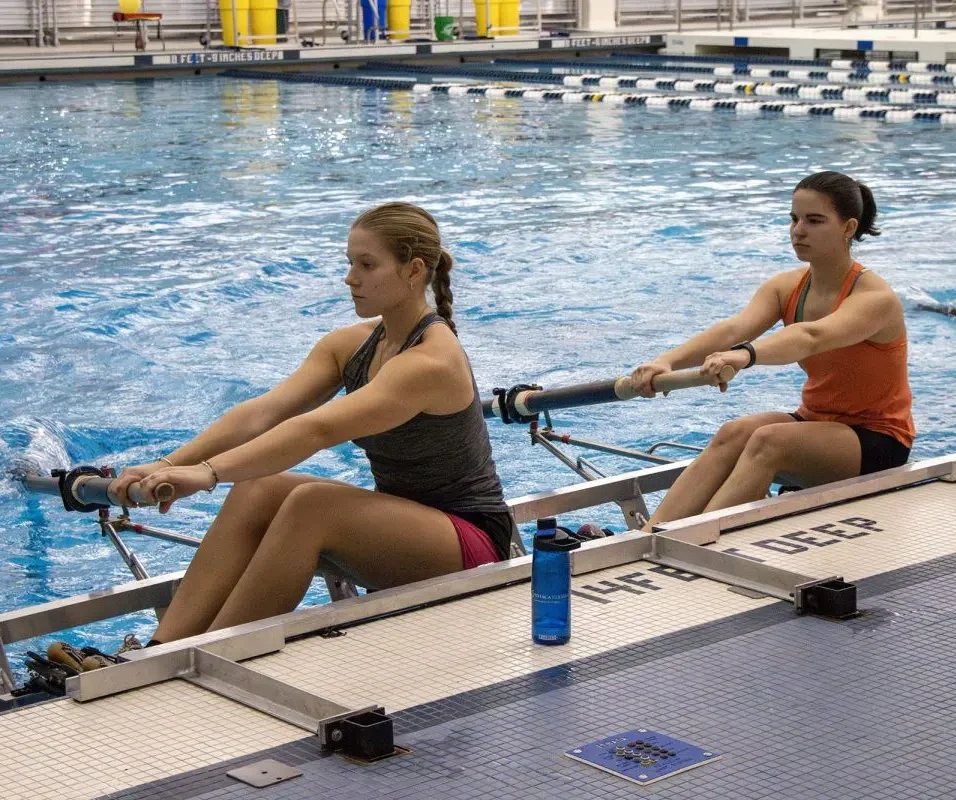
As a college rower, you become part of a high-performance program where everything revolves around improving, competing and working together as a team:
- A complete coaching staff: Daily guidance from a head coach, specialized assistants for sweep and sculling, and often a dedicated coach for coxswains.
- Leading rowing facilities: Your own boathouse on the water, docks for launching boats, training facilities with Concept2 ergometers, weights and other fitness equipment.
- An intensive training schedule: Expect to train six days a week, combining early morning sessions on the water with demanding afternoon workouts on the ergometer or in the weight room.
- Large squads and multiple boats: With teams ranging from around 40 to as many as 68 athletes, you compete for your place in the first varsity eight (1V), second varsity eight (2V) or one of the smaller boats. This creates healthy and motivating competition within the team.
- Medical and sports performance support: Many programs provide daily access to athletic trainers and other medical staff for injury prevention, rehabilitation and recovery.
Head season, sprint season and the national championships
The American rowing season is divided into two different types of competition:
- Fall (head season): During the fall, rowers compete in long-distance head races of around 5,000 to 6,000 meters, using rolling starts. One of the most famous events is the Head of the Charles Regatta in Boston.
- Spring (sprint season): During the spring, the focus shifts to the Olympic 2,000-meter distance, raced on official six- or eight-lane courses where crews compete side by side for the win.
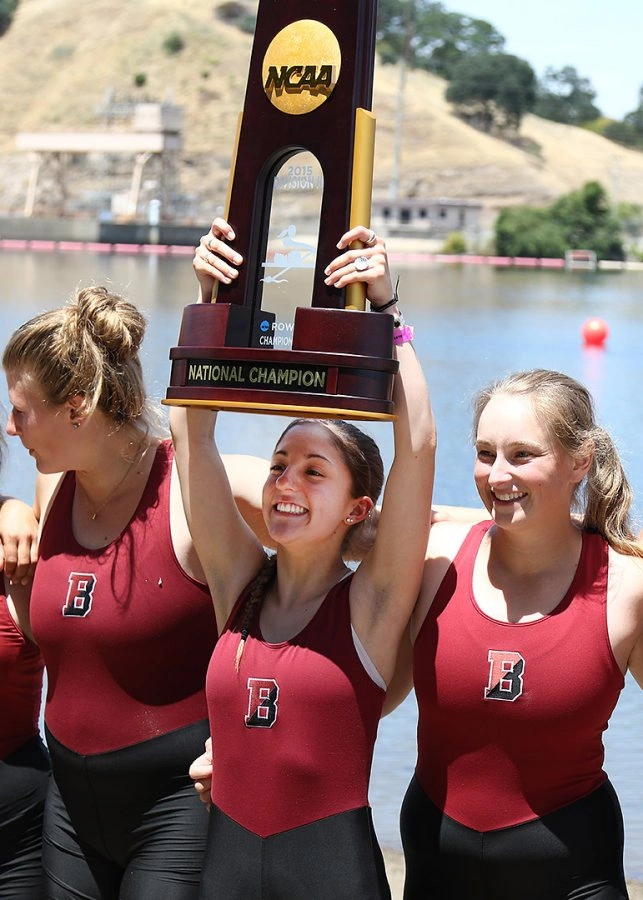
The season reaches its climax at the end of the spring. Women’s teams compete at the NCAA Rowing Championships, with separate national championships for Divisions I, II and III. Men’s programs traditionally compete for the prestigious IRA National Championship.
Strong universities and colleges for rowing
When looking for universities or colleges with strong rowing programs and good scholarship opportunities, it is important to understand that things can change from year to year. Coaching staff, recruiting classes, budgets and available scholarship money all play a role.
Strong examples by division
- NCAA Division I women: University of Texas, the University of Washington and Stanford University are among the programs that regularly compete for national titles and can offer substantial athletic scholarship opportunities.
- Division I men (IRA): UC Berkeley (Cal), the University of Washington, Northeastern University and Boston University.
- Division III (men and women): Williams College, Tufts University and Bates College. Athletic scholarships are not permitted, but students may qualify for academic scholarships and other forms of financial aid.
Programs that actually offer athletic scholarships
Ivy League universities such as Harvard, Yale and Princeton, as well as all NCAA Division III schools, are not permitted to offer athletic scholarships. If athletic scholarship money is an important part of your college plans, NCAA Division I and Division II programs — as well as men’s IRA programs that offer athletic aid — are generally the most relevant options.
Overview of an academic year
A year as a student-athlete consists of several different phases:
August - November
Fall season
On-water training, technical work and strength training, along with major fall regattas and preparation for the main racing season.
March – early June
Spring season
The official 2,000-meter sprint season, with weekly dual races, conference championships and the national NCAA or IRA championships.
December – February
Winter training period
The indoor phase includes Concept2 erg testing, strength training and, for many teams, a training camp in a warmer state such as Florida or California.
June – August
Summer break
More than two and a half months of summer break, giving you time to fly back to the Netherlands or compete for national teams, such as the Dutch U23 or senior national team.
A day in the life of a college rower
With access to excellent facilities and a schedule built around training and recovery, life as a college rower can be very different from combining rowing and studying in the Netherlands.
5:45
On-water practice7:45
Shower/Breakfast8:30
Classes11:45
Lunch12:30
Classes15:00
Second training session17:30
Recover/Shower/Dinner19:00
Study/Leisure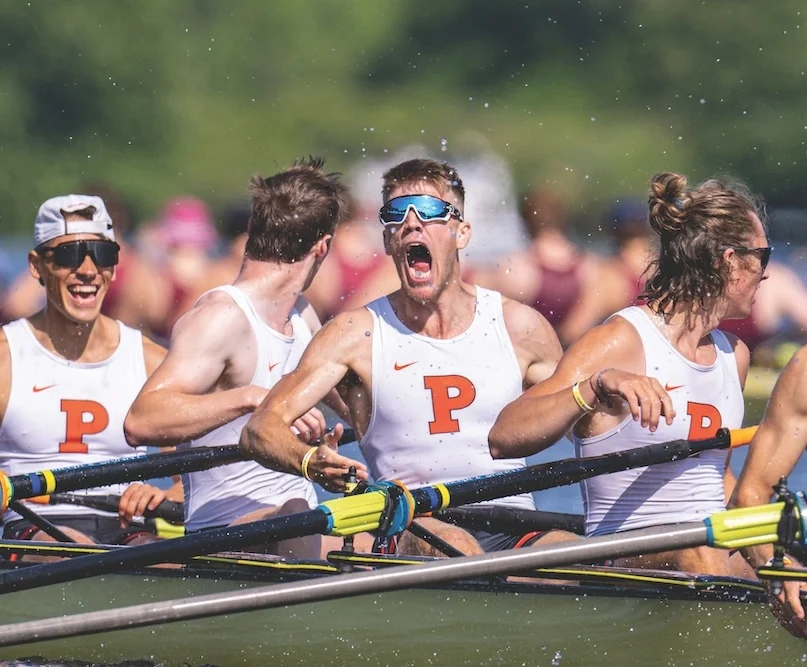
Three surprising facts about college rowing
- One of America’s oldest college sports: Rowing helped lay the foundation for American college sports. The historic Harvard-Yale Regatta was first raced in 1852, almost ten years before the outbreak of the American Civil War.
- Men’s rowing operates separately from the NCAA: While women’s rowing is one of the major NCAA championship sports, men’s rowing has been organized independently through the Intercollegiate Rowing Association (IRA) since 1895. As a result, men’s rowing is not subject to the NCAA’s centralized scholarship rules.
- The importance of novices and walk-ons: Because of the size of some college rowing squads — with up to 68 athletes on Division I women’s rosters — many programs include athletes who joined the sport later. Talented athletes who switch from sports such as swimming, basketball or track and field can sometimes develop into varsity rowers within one or two years.
Curious about your chances?
Are you a competitive rower and wondering whether you could qualify for an athletic scholarship or a strong academic scholarship? And are you curious about what your personal records and academic results could be worth at an American university?
Schedule a no-obligation consultation with Made Scholarships. Together, we will look at your athletic and academic profile and give you a clear overview of the universities and colleges that could be a good fit for your American dream.