
Track and field scholarship in the USA: study and compete in college athletics
Would you like to combine your passion for track and field with an accredited bachelor’s degree? Nowhere in the world is track and field as large and professionally organized as it is in the United States. Whether you are a sprinter, distance runner, thrower, or jumper, there are plenty of opportunities to earn a track and field scholarship in the USA. You will train in state-of-the-art facilities and work alongside a team of specialists, with opportunities available for talented athletes at different levels. For distance runners, track and field and cross country are often closely connected and can form an important part of the college experience.
As a student-athlete, you will also learn how to perform in a team environment while developing skills such as structure, time management, and teamwork—qualities that can benefit you both on and off the track.

How does a track and field scholarship in the USA work?
One of the great things about track and field is that it is a highly measurable sport. Compared with many team sports, track and field scholarships depend less on a scout’s personal impression and more on your actual performances: your personal records (PRs), times, heights, and distances.
American coaches compare your PRs with their own recruiting standards to determine where you may be a good fit within organizations such as the NCAA, NAIA, or NJCAA.
The coach plays an important role in the scholarship process, but the scholarship itself is ultimately awarded by the university. Depending on your athletic level and the available team budget, your scholarship may range from a substantial partial award to a full ride that covers almost all of your expenses.
At Made Scholarships, we help you make the most of the financial opportunities available to you. Many student-athletes do not realize that different sources of financial aid can sometimes be combined (stacking):
- Athletic scholarship: Financial support based on your athletic ability and performances.
- Academic scholarship: Additional financial support for strong grades in secondary school, your GPA, and admission test scores such as the SAT or ACT.
- International scholarship: Special scholarships offered by universities to attract talented international students.
Track and field scholarship standards and recruiting levels
With more than 1,000 universities and colleges in the United States, there is a place for athletes at many different levels. You do not have to be a world-class athlete yet to have opportunities. If you are passionate about track and field, there may be a college program that matches your current level and future potential.
To make things easier, we have listed general performance standards for men’s and women’s track and field by division. Keep in mind that these are guidelines. Individual universities and colleges remain free to set their own recruiting standards.
NCAA Division 1 limits
| Event | Men (Guideline) | Women (Guideline) |
|---|---|---|
| Sprints & Hurdles | ||
| 100m | 10.40s – 10.80s | 11.50s – 11.85s |
| 200m | 20.80s – 21.50s | 23.10s – 23.90s |
| 400m | 46.20s – 49.10s | 53.80s – 1:01.00m |
| 110mH / 100mH | 14.00s – 15.60s (110mH) | 13.50s – 14.05s (100mH) |
| 400mH | 50.70s – 55.30s | 59.90s – 1:01.30m |
| Middle & Long Distance | ||
| 800m | 1:47.1m – 1:58.5m | 2:09.0m – 2:22.0m |
| 1500m | 3:45.0m – 4:16.0m | 4:12.0m – 4:42.0m |
| 5,000m (5K) | 14:55m – 16:22m | 17:15m – 19:08m |
| 3,000m Steeplechase | 8:41m – 12:20m | 9:49m – 12:39m |
| Jumps | ||
| Long Jump | 6.60 m – 7.35 m | 5.65 m – 6.40 m |
| High Jump | 1.93 m – 2.11 m | 1.60 m – 1.78 m |
| Pole Vault | 4.40 m – 5.45 m | 3.65 m – 4.30 m |
| Triple Jump | 13.60 m – 15.10 m | 12.00 m – 13.15 m |
| Throws & Multi-Events | ||
| Shot Put | 16.00 m – 20.20 m | 12.90 m – 17.00 m |
| Discus Throw | 42.50 m – 56.70 m | 40.40 m – 53.80 m |
| Javelin Throw | 57.00 m – 70.20 m | 35.20 m – 52.80 m |
| Multi-Event | 5,200 – 7,600 pts (Decathlon) | 4,400 – 5,750 pts (Heptathlon) |
NCAA Division 2 limits
| Event | Men (Guideline) | Women (Guideline) |
|---|---|---|
| Sprints & Hurdles | ||
| 100m | 10.60s – 11.00s | 11.95s – 12.90s |
| 200m | 21.25s – 22.70s | 24.25s – 25.00s |
| 400m | 47.55s – 50.00s | 55.10s – 59.55s |
| 110mH / 100mH | 14.40s – 15.70s (110mH) | 13.70s – 15.95s (100mH) |
| 400mH | 52.25s – 1:00.30m | 1:01.00m – 1:10.70m |
| Middle & Long Distance | ||
| 800m | 1:48.9m – 1:58.8m | 2:09.2m – 2:34.5m |
| 1500m | 3:46.7m – 4:05.5m | 4:27.4m – 5:16.4m |
| 5,000m (5K) | 14:17m – 15:36m | 17:00m – 21:10m |
| 3,000m Steeplechase | 9:03m – 9:54m | 12:50m – 13:00m |
| Jumps | ||
| Long Jump | 6.60 m – 7.45 m | 5.13 m – 6.02 m |
| High Jump | 1.88 m – 2.11 m | 1.52 m – 1.70 m |
| Pole Vault | 4.35 m – 5.08 m | 2.90 m – 3.80 m |
| Triple Jump | 13.55 m – 15.35 m | 10.95 m – 12.30 m |
| Throws & Multi-Events | ||
| Shot Put | 14.75 m – 17.70 m | 11.80 m – 15.24 m |
| Discus Throw | 44.35 m – 52.45 m | 35.35 m – 49.20 m |
| Javelin Throw | 51.75 m – 64.65 m | 29.50 m – 44.35 m |
| Multi-Event | 4,535 – 6,940 pts (Decathlon) | 3,680 – 4,970 pts (Heptathlon) |
NCAA Division 3 limits
| Event | Men (Guideline) | Women (Guideline) |
|---|---|---|
| Sprints & Hurdles | ||
| 100m | 10.90s – 11.35s | 12.35s – 13.25s |
| 200m | 21.75s – 23.70s | 25.40s – 27.00s |
| 400m | 48.00s – 51.75s | 55.65s – 1:01.00m |
| 110mH / 100mH | 14.75s – 16.30s (110mH) | 14.40s – 18.50s (100mH) |
| 400mH | 52.00s – 59.50s | 1:01.00m – 1:10.70m |
| Middle & Long Distance | ||
| 800m | 1:54.9m – 1:59.7m | 2:11.5m – 2:30.7m |
| 1500m | 3:55.8m – 4:06.8m | 4:34.0m – 5:08.8m |
| 5,000m (5K) | 14:56m – 15:24m | 17:25m – 21:30m |
| 3,000m Steeplechase | 9:16m – 10:25m | 10:41m – 12:47m |
| Jumps | ||
| Long Jump | 6.70 m – 7.20 m | 5.00 m – 5.70 m |
| High Jump | 1.85 m – 2.05 m | 1.42 m – 1.70 m |
| Pole Vault | 4.10 m – 4.80 m | 2.90 m – 3.65 m |
| Triple Jump | 12.90 m – 14.75 m | 10.20 m – 11.75 m |
| Throws & Multi-Events | ||
| Shot Put | 11.95 m – 16.20 m | 10.65 m – 13.75 m |
| Discus Throw | 37.00 m – 50.50 m | 34.25 m – 44.50 m |
| Javelin Throw | 35.00 m – 62.30 m | 31.40 m – 40.00 m |
| Multi-Event | 4,165 – 6,580 pts (Decathlon) | 3,180 – 4,485 pts (Heptathlon) |
NAIA limits
| Event | Men (Guideline) | Women (Guideline) |
|---|---|---|
| Sprints & Hurdles | ||
| 100m | 10.75s – 11.40s | 12.15s – 13.00s |
| 200m | 22.10s – 23.00s | 24.80s – 26.45s |
| 400m | 48.70s – 50.95s | 56.70s – 59.60s |
| 110mH / 100mH | 14.50s – 16.80s (110mH) | 14.85s – 18.65s (100mH) |
| 400mH | 56.40s – 1:02.90m | 1:04.50m – 1:14.50m |
| Middle & Long Distance | ||
| 800m | 1:55.5m – 2:05.4m | 2:15.2m – 2:41.5m |
| 1500m | 3:55.4m – 4:26.8m | 4:35.4m – 5:45.4m |
| 5,000m (5K) | 15:05m – 17:45m | 17:53m – 22:00m |
| 3,000m Steeplechase | 9:22m – 10:02m | 11:07m – 12:55m |
| Jumps | ||
| Long Jump | 6.10 m – 7.15 m | 5.20 m – 5.70 m |
| High Jump | 1.83 m – 2.03 m | 1.32 m – 1.68 m |
| Pole Vault | 4.10 m – 4.75 m | 3.05 m – 3.65 m |
| Triple Jump | 12.65 m – 14.65 m | 9.80 m – 11.50 m |
| Throws & Multi-Events | ||
| Shot Put | 11.70 m – 17.00 m | 9.85 m – 13.50 m |
| Discus Throw | 32.80 m – 49.90 m | 30.50 m – 42.50 m |
| Javelin Throw | 37.40 m – 59.80 m | 23.80 m – 39.80 m |
| Multi-Event | 4,245 – 6,460 pts (Decathlon) | 3,200 – 4,465 pts (Heptathlon) |
NJCAA limits
| Event | Men (Guideline) | Women (Guideline) |
|---|---|---|
| Sprints & Hurdles | ||
| 100m | 10.80s – 11.60s | 12.30s – 13.30s |
| 200m | 22.00s – 23.80s | 25.20s – 27.50s |
| 400m | 48.50s – 52.50s | 57.00s – 1:03.00m |
| 110mH / 100mH | 14.80s – 17.20s (110mH) | 15.00s – 19.00s (100mH) |
| 400mH | 55.50s – 1:04.00m | 1:05.00m – 1:16.00m |
| Middle & Long Distance | ||
| 800m | 1:55.0m – 2:07.0m | 2:18.0m – 2:45.0m |
| 1500m | 3:58.0m – 4:30.0m | 4:40.0m – 5:50.0m |
| 5,000m (5K) | 15:10m – 18:00m | 18:00m – 22:30m |
| 3,000m Steeplechase | 9:30m – 10:45m | 11:30m – 13:30m |
| Jumps | ||
| Long Jump | 6.20 m – 7.10 m | 5.00 m – 5.60 m |
| High Jump | 1.80 m – 2.00 m | 1.35 m – 1.65 m |
| Pole Vault | 4.00 m – 4.70 m | 2.90 m – 3.50 m |
| Triple Jump | 12.50 m – 14.30 m | 9.60 m – 11.30 m |
| Throws & Multi-Events | ||
| Shot Put | 11.50 m – 16.50 m | 9.50 m – 13.00 m |
| Discus Throw | 32.00 m – 48.00 m | 29.00 m – 41.00 m |
| Javelin Throw | 36.00 m – 58.00 m | 23.00 m – 38.00 m |
| Multi-Event | 4,000 – 6,200 pts (Decathlon) | 3,000 – 4,300 pts (Heptathlon) |
What does a scholarship cover?
Tuition
Your scholarship can cover the full cost of tuition, which can range from $10,000 to over $70,000 per year.
Training gear
You will receive a complete set of team apparel, spikes, shoes, and other gear from top brands, all provided by the university.
Room&Board
The costs for your room on campus ('dorms') and your daily 'meal plan' can be fully covered by your scholarship.
Insurance
It is mandatory to have health insurance and some schools require international students to take a school’s policy.
Books
A significant expense that is often included in your scholarship package, saving you between $400 and $1200 annually.
Spending money
With a 'full ride' scholarship, you may even receive an extra monthly stipend for personal expenses.
Life as a college track and field athlete: training and competition
As a current or future student-athlete, you enter a highly professional sporting environment. You may work with an entire team of specialists and have access to facilities that would be difficult to find elsewhere. Here is what can be part of the experience:
- A complete coaching staff: Support from a head coach and specialist coaches for your specific discipline, whether that is sprinting, throwing, jumping, distance running, or another event.
- First-class facilities: Access to state-of-the-art indoor and outdoor tracks, extensive weight rooms, and professional athletic training facilities.
- Medical support: Regular access to athletic trainers who help with injury prevention, treatment, and recovery.
- Professional team gear: Extensive packages of team clothing and equipment from major brands, often customized with your university’s logo.


Travel across America and compete for a championship
College athletics in the United States is a real team experience. Although track and field is often viewed as an individual sport, in America you compete for your college or university. The competitive year is divided into an indoor season, with meets held on impressive indoor tracks, and an outdoor season that takes place during the traditional track season. But the experience goes far beyond competition.
Travel as a team: You will regularly travel with your teammates, who often become some of your closest friends. Depending on your program, you may compete throughout your region or travel much farther across the country. Long bus rides, team dinners, hotel stays, and flights to major competitions all become part of the experience.
The dream of Nationals: The ultimate goal is to qualify through your conference and reach the national championships. This is where the best college track and field athletes from across the United States compete for a national title.
Strong universities and colleges for track and field
The United States is home to hundreds of strong college track and field programs. The university that suits you best depends on much more than athletic level alone. Your specific event, personal records, academic profile, preferred degree program, and financial situation all matter.
Below, we highlight a few examples of strong programs in different divisions. Consider these schools as a first impression rather than a definitive ranking. Team strength and recruiting needs can change from season to season and may differ significantly by event.

Strong examples:
Stanford University
Princeton University
University of Florida

Strong examples:
Massachusetts Institute of Technology
Johns Hopkins University
University of Chicago
Strong examples:
Colorado school of Mines
Hillsdale College
West Chester University
Strong examples:
Dordt University
Indiana Wesleyan University
University of California – Merced
Overview of an academic year

The Fall semester (often referred to as off-season) is used to prepare intensively for the coming Spring season. Some Track athletes are also part of the cross-country team who have their main season in the Fall.

Showtime! – The season begins with indoor meets at the beginning of the Spring and will end with the National indoor tournament. This is quickly followed by a shift to outdoor meets until the National Championships officially close the college season in mid-June.


Summer break – There is a possibility to stay in The USA and take summer classes or work in camps. Most students decide to go back to their families to enjoy the 2.5-month break to rest and individual preparation for pre-season.
Day in the life of a student-athlete
Sports & academics are 100% coordinated, so you have the opportunity to excel on both the track as well as in the classroom. Curious to see what this looks like? Watch videos showing how some of our student-athletes spend their day.
6:30
Weight/conditioningWake up and get ready for your morning strength and conditioning session.
7:45
Shower/BreakfastAfter training, you shower and have breakfast with teammates or friends at one of the dining facilities on campus.
8:30
ClassesYour first classes of the day begin.
11:45
LunchTime for lunch with teammates and friends at one of the dining halls on campus.
12:30
ClassesYou return to class for your afternoon lectures.
14:30
PracticeYou get ready for afternoon practice. Before training, you may visit the athletic training room to get taped or receive treatment from an athletic trainer.
17:30
Recover/Shower/DinnerAfter practice, you may return to the athletic training room for treatment or recovery, such as an ice bath or other forms of physical therapy. After showering, you have dinner with teammates and friends.
19:00
Study/LeisureTime for homework. It is also common for student-athletes to attend competitions or games involving other university teams to support fellow students. The rest of the evening is yours to spend as you like.

4 surprising facts about college track and field
- A major pathway to the Olympic Games: Like swimming, the American college system is an important development pathway for Olympic talent. If the NCAA had competed as its own country at the Paris 2024 Olympic Games, NCAA student-athletes and alumni would have collectively ranked second in the medal table. More than 1,200 current and former NCAA athletes won a combined 330 medals.
- Specialist coaching for every event: Whether you are a pole vaulter, hammer thrower, hurdler, or distance runner, a strong university can provide specialist coaching focused specifically on your event. That level of expertise is difficult to find outside the college system.
- Two seasons, two chances to succeed: One of the unique aspects of college track and field is the combination of an indoor and outdoor season. This gives athletes two opportunities each year to compete at major meets and potentially qualify for a national championship.
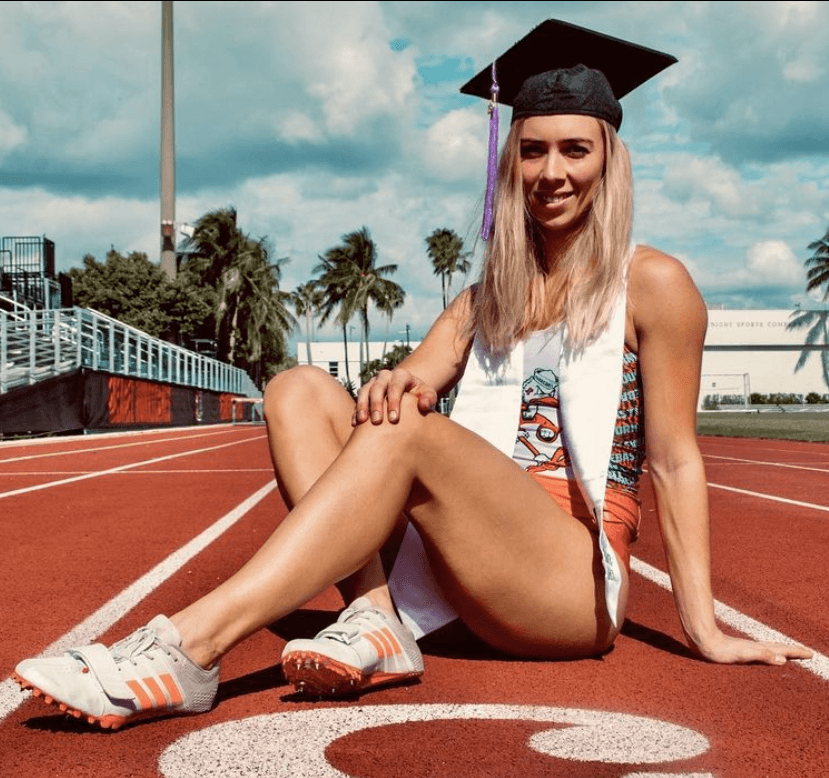
- A real-life example: Our track and field ambassador, Anna Sjoukje Runia, is a great example of what can be possible. She combined her athletic talent with a full athletic scholarship at the University of Miami, a top NCAA Division I program. She now uses her experience to help inspire and guide the next generation of student-athletes.
Curious about your chances?
Request a free, no-obligation evaluation. We'll map out your personal opportunities.