

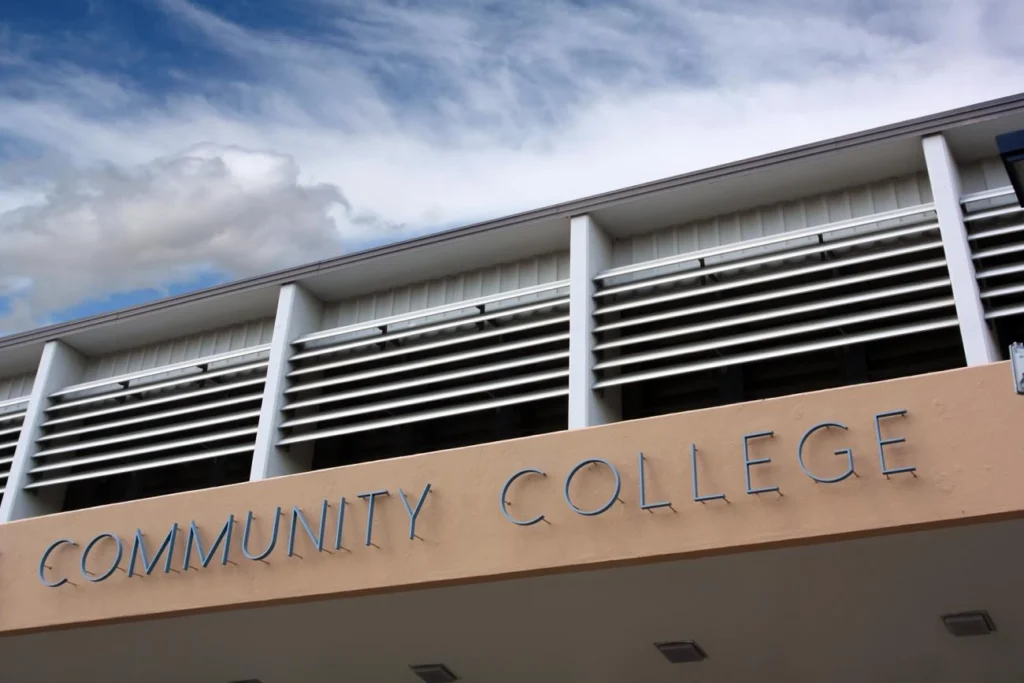
A community college is a two-year higher education institution in the United States where students earn an Associate Degree. For many international student-athletes, attending a community college (often referred to in the sports world as a junior college or JUCO) serves as a strategic launchpad toward earning a bachelor's degree in America. This pathway allows student-athletes to reduce tuition costs, gain valuable collegiate athletic experience, and seamlessly transfer into a four-year university. Outside the United States, there is sometimes a misconception that community colleges offer a "lower quality" of education. That is simply not true. Community colleges deliver the exact same foundational undergraduate coursework as the first two years at a four-year university, at a fraction of the cost, paired with exceptional athletic opportunities.
How does a community college work?
A community college is a two-year higher education institution. Instead of awarding a four-year undergraduate degree (Bachelor’s Degree), students complete their studies after two years with an Associate Degree.
The academic curriculum during these first two years focuses primarily on general education requirements (General Electives), such as English composition, college mathematics, history, and introductory psychology.
The key advantage? These general education classes are academically equivalent to the lower-division coursework taken by freshmen and sophomores at four-year universities.
Want to know which majors and courses you can choose? Read more about college majors, minors, and general electives in the US.
The 2+2 route: how to earn your full bachelor’s degree
Most student-athletes do not view a community college as an end goal, but rather as a stepping stone toward a four-year college or university. This model is widely known as the 2+2 route:
- Years 1 & 2 (Community College): You complete your general education requirements, compete in high-level college athletics, and earn your Associate Degree after two years.
- Years 3 & 4 (Four-Year University): You transfer your earned course credits (Transfer Credits) directly into the junior year (third year) of a four-year university across the NCAA (D1, D2, D3) or NAIA. Here, you focus entirely on your major field of study and complete your full Bachelor’s Degree two years later.
When you graduate, your bachelor’s diploma carries the name of your final four-year university. Employers only see your final degree-granting institution, even though you saved thousands of dollars along the way.
Competing in JUCO athletics: understanding the NJCAA
Community colleges play a major role in the American college sports system. While four-year institutions operate under the NCAA or NAIA, most junior colleges compete under the NJCAA (National Junior College Athletic Association) or the CCCAA (California Community College Athletic Association).
Competing at the JUCO level offers distinct athletic advantages:
- Immediate playing time: At large Division I programs, freshmen often spend their first season on the bench. Because junior colleges only feature first- and second-year student-athletes, your opportunities to earn starting roster spots right away are significantly higher.
- A proven bridge to NCAA Division I and II: NCAA Division I and D2 head coaches actively recruit the JUCO ranks. If you perform well in junior college athletic competition, you can secure strong transfer opportunities to top-tier four-year programs.
- Athletic scholarship availability: The NJCAA allows programs to offer full and partial athletic scholarships to cover tuition, fees, room, and board.
The primary advantages of attending a community college
There are several strategic reasons why starting at a community college might be the right path for your academic and athletic goals:
Significant cost savings
Tuition rates at community colleges are substantially lower than at four-year universities. Completing your first two years at a junior college can save families tens of thousands of dollars in overall educational expenses.
Flexible admissions requirements & GPA recovery
If your high school grades (GPA) fell below direct NCAA eligibility standards, or if you struggled with standardized testing (such as the SAT, ACT, or TOEFL), community colleges offer more accessible admissions criteria. SAT or ACT scores are rarely required for admission. You can spend two years building a strong college GPA before transferring to an NCAA program.
Smaller class sizes and personalized instruction
While introductory lectures at major state universities can seat up to 200 students, community college classes are kept small (typically 15 to 25 students). This environment allows for direct interaction with professors, making the transition to studying in English much easier.
Key considerations when choosing a community college
To make an informed choice, keep these practical factors in mind:
- Transferring is required for a Bachelor’s: If your goal is a four-year degree, you must transfer to a four-year institution after completing your Associate Degree.
- Campus housing availability: Not every community college operates traditional student housing. At Made Scholarships, we specifically partner with institutions that provide reliable housing options, such as on-campus residence halls or nearby student apartment complexes. On-campus options typically include university meal plans, while off-campus apartments usually involve self-catering.
Is a community college the right route for you?
A community college is not a step down—it is a smart, strategic pathway designed to lower educational costs, maximize playing time, and strengthen your overall academic profile.
At Made Scholarships, we evaluate your athletic evaluation, academic transcripts, and family budget to determine whether direct four-year university placement or the 2+2 JUCO pathway aligns best with your future goals.
Contact our team today for a personal consultation!